
Nature Trail and Map
While committed to the wider Stewarton area, many of the charity’s volunteers devote much of their effort to maintaining paths and open spaces within Lainshaw Woods.
Lainshaw Woods is just a short distance from Stewarton’s town centre. Walking from Stewarton Cross to the main entrance to the Woods takes around 7 minutes. Head west along Lainshaw Street and enter David Dale Avenue at the roundabout under the Stewarton railway viaduct. The main entrance to Lainshaw Woods is then a short distance along David Dale Avenue on the left-hand side. (Find the start of David Dale Avenue on Google Maps.)
Within the Lainshaw Woods you will find a nature trail that is marked by a series of information panels. The trail is indicated by the red dotted line in the map shown below.
The original map appears on a panel at the main entrance to Lainshaw Woods in David Dale Avenue, Stewarton. (IMPORTANT: The map is oriented for the benefit of viewers stood physically in front of the panel. So, South is ‘UP’ and West is ‘RIGHT’. Annick Water bounds the South edge of the Woods.)
Visitors with mobility issues should note that, on the Nature Trail, there is a set of steps between the Wastewater Treatment Works (‘Works’) outflows and Anderson’s Mount. This is marked as a sequence of red blocks of increasing size on the map.
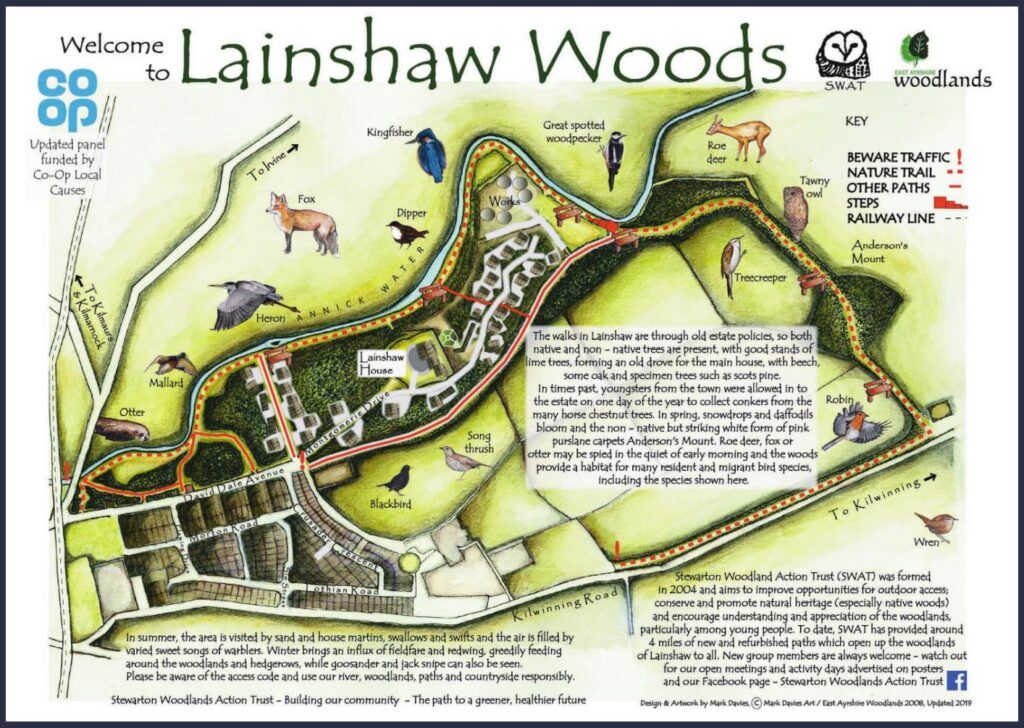
Depending on the time of year and time of day, mammals, insects and birds that you may see in and around Lainshaw Woods and Annick Water include:
- Grey herons
- Kingfishers
- Great spotted woodpeckers
- Roe deer
- Blackbirds
- Song thrushes
- Dippers
- Bullfinches
- Otters
- Bats
- Peacock butterflies
- Treecreepers
- Red Admiral butterflies
- Sand martins
- Goldfinches
- Painted Lady butterflies
- Red foxes
- Sparrows
- House martins
- Swallows
- Mallard ducks
- Tortoiseshell butterflies
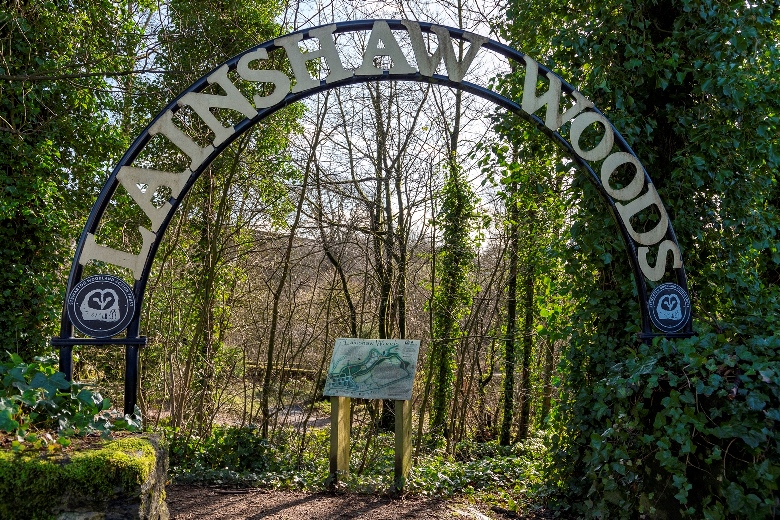
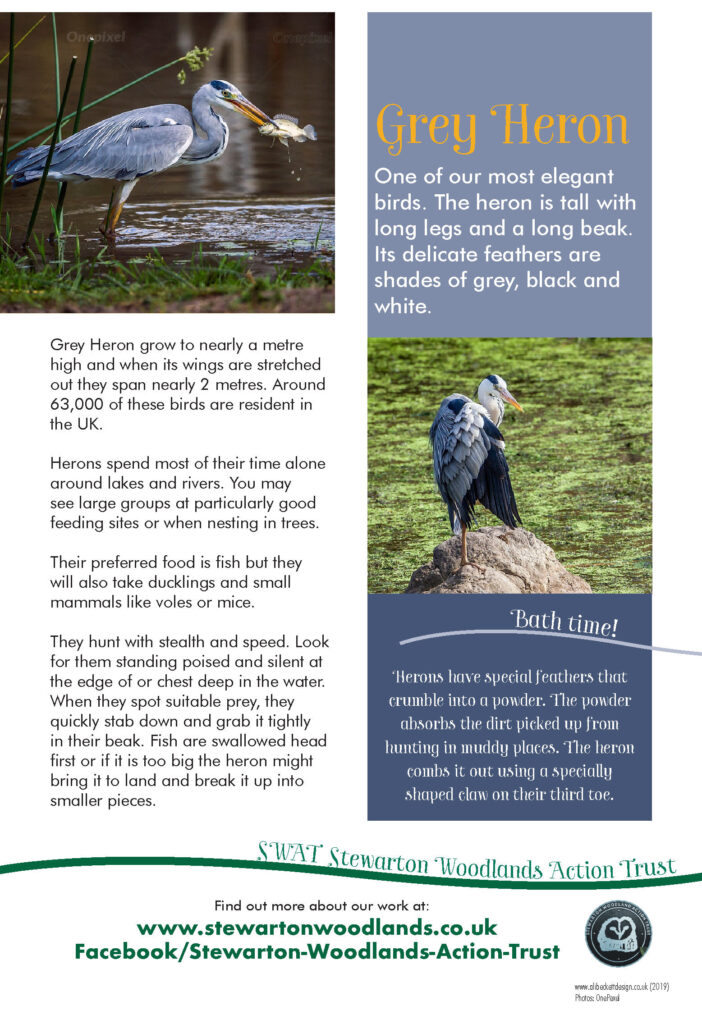
Below is an example of the type of Information Panel that can be found at various points around the Nature Trail.
Invasive, Non-Native Plants in Lainshaw Woods
Giant Hogweed is a dangerous invasive species that produces toxic sap. All parts of the plant should be avoided. We have produced an updated Giant Hogweed Identification Poster. Distribution of Giant Hogweed in the UK is widespread. It is often found near rivers and other watercourses. Around Stewarton, it is mainly found on or near the banks of the Clerkland Burn and Annick Water. In addition to the information provided here and on the NNSS website, you can find a useful video summary published on Instagram by Danielle Gallacher.
Japanese Knotweed is highly invasive and can quickly crowd out native plant species. Once established, it is difficult to eradicate. Several stands of Japanese Knotweed are present in Lainshaw Woods including on the slope below The Viewpoint.
Rhododendron Ponticum is the only species of rhododendron that is officially designated as an non-native, invasive weed in Scotland. We control specimens of Rhododendron Ponticum in Lainshaw Woods by digging them up and then destroying them safely by burning.